Originally Posted On: https://steamsaunadepot.com/blogs/news/why-steam-generators-for-showers-are-replacing-spa-memberships-for-many-homeowners
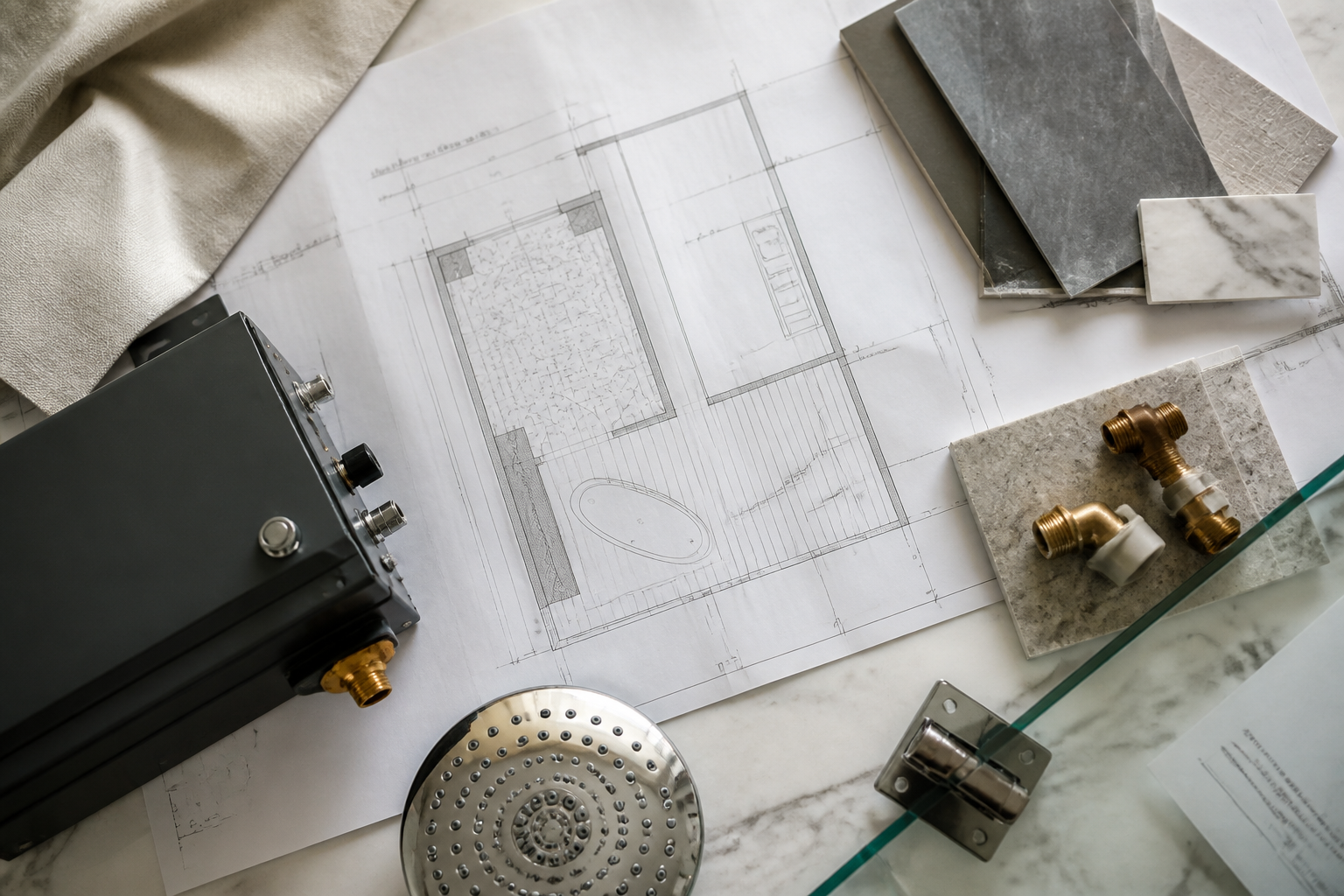
Key Takeaways
- Compare the real cost of steam generators for showers against recurring spa fees, travel time, and missed use—daily access at home often shifts the value equation faster than clients expect.
- Size steam generators for showers by total cubic footage, finish materials, ceiling height, and glass area; getting the load wrong on paper is one of the fastest ways to create poor performance on site.
- Prioritize the features that change day-to-day ownership, including fast start, auto-drain, simple controls, and clear service access—those details matter more than a long feature list.
- Plan steam systems for showers early in the drawing set so framing, waterproofing, power, drainage, and control locations all support the final enclosure instead of forcing late-stage compromises.
- Specify steam generators for showers with the same discipline used for other mechanical equipment: verify enclosure conditions, maintenance access, and finish coordination before approval, not after rough-in.
- Review product-page signals carefully if a buyer is sourcing now; clear sizing guidance, complete package details, lead times, and installation requirements usually separate serious system options from vague listings.
Spa math is getting ugly for monthly members.
A household paying $150 to $300 per month for club access can burn through $1,800 to $3,600 a year, and that’s before travel time, scheduling friction, or the fact that shared steam rooms rarely feel private. For builders and design pros tracking buyer demand, steam generators for showers have moved out of the wish-list category and into core primary-bath planning. Fast. What looked like an indulgence five years ago now reads more like a daily-use wellness fixture.
That shift isn’t driven by hype. It’s driven by use. Homeowners want heat therapy on their own schedule—before work, after training, late at night—and they want it inside an enclosure that actually fits the architecture, not tucked into a clubhouse locker area. In practice, the decision turns on ownership math, enclosure design, and system sizing more than aesthetics alone (though finish coordination still matters). And for specification-driven teams, the early choices—glass area, ceiling height, control location, service access—end up deciding whether the finished shower feels ordinary or earns its footprint.
Why steam systems for showers are gaining ground in residential design
Quiet shift. Across custom residential work, wellness upgrades have moved out of the bonus category and into early specification talks, especially as clients compare recurring spa costs with permanent in-home options. For builders and design teams, steam generators for showers now sit in the same planning tier as heated floors, smart lighting, and whole-home audio.
The shift from occasional spa visits to daily in-home wellness
The appeal isn’t hard to read. A household paying $150 to $300 a month for club access can cross $1,800 to $3,600 a year before counting travel, parking, guest fees, or the simple fact that busy clients skip sessions they’ve already paid for. At home, the use pattern changes—shorter sessions, more often, and usually at the exact moment the user wants relief rather than at the club’s schedule.
Why builders and designers are specifying steam-ready showers earlier in the plan set
In practice, teams that wait too long create cost creep. A sealed enclosure, proper ceiling treatment, access for service, and control placement all need room in the plan set. Retrofitting after tile selection is where budgets get ugly fast.
The cost comparison that keeps changing the conversation
That math keeps pushing the category forward. A well-planned package for steam showers can cost more upfront, yes, — owners who use it four or five times a week often view the spend as part wellness tool, part property upgrade, part daily habit. And unlike a membership, it doesn’t reset every month.
Steam systems for showers vs. spa memberships: the real ownership math
Bluntly, the comparison is no longer product price versus membership fee. It’s recurring access versus owned infrastructure. That’s a different decision.
The difference shows up fast.
Upfront product and installation costs compared with recurring membership fees
A residential system may land anywhere from the low four figures to the higher end once controls, finish components, electrical work, waterproofing upgrades, and labor are counted. Yet over five years, a $225 monthly spa habit totals $13,500. Add two users in one household, and the comparison gets tighter—fast.
Time savings, privacy, and daily access are part of the value equation
Privacy changes usage more than spec sheets do. Owners don’t need to drive 20 minutes, check hours, share facilities, or build the day around a club visit. Realistically, that convenience is why the system gets used on Tuesday nights, early mornings, and the 15-minute gap before dinner.
Which homeowners see payback fastest in actual use
The quickest payback tends to show up in three groups:
- Frequent wellness users replace club visits three or more times per week
- Busy professionals who value time more than the membership discount
- Custom-home owners are already investing in premium bath space and planning to stay put for years
For these buyers, the hunt usually starts with comparison phrases like best shower steam generator, not broad inspiration terms. They’re past daydreaming. They’re sourcing.
How to choose the right steam system for a shower without sizing mistakes
Here’s what most people miss: the room doesn’t care about the floor plan alone. It reacts to volume, surface material, heat loss, and enclosure quality. Miss one of those, and the equipment underperforms, or the budget gets padded to hide a planning error.
Worth pausing on that for a second.
Cubic-foot calculations and why finish materials change the load
Volume is the starting point, not the finish line. A compact enclosure might call for a 6kw steam shower generator in one project and more output in another if the walls are dense stone, the bench is masonry, or the glass area is oversized. Designers specifying book-matched marble or slab quartz should assume higher heat absorption from the start.
A medium enclosure may pencil toward a 9kw steam shower generator, but only after the material load is checked. That’s why generic online sizing charts often miss—they read dimensions, not assemblies.
How exterior walls, glass, and ceiling height affect equipment selection
Three common load multipliers show up again and again:
- Exterior wall exposure that pulls heat from the enclosure
- Large glass sections that cool faster than insulated wall assemblies
- Tall ceilings that increase volume and slow perceived room fill
And yes, the phrase steam shower generator for small showers can be misleading. Small on paper doesn’t always mean small in load if the room is heavy in stone and light on insulation.
Features that matter most: fast start, auto-drain, control options, and maintenance access
Spec sheets are crowded, but a few items do the real work. Buyers comparing steam generator heat-up time are usually trying to predict actual daily use, because a system that reaches session-ready output in about a minute to a few minutes gets used differently from one that feels slow every single day.
The difference shows up fast.
Auto-drain matters. Service access matters more than clients think. And control location matters twice—once for code and function, once for the finished visual line (that detail always lands late if nobody owns it early).
What new-home builders, architects, and interior designers need to get right early
Early coordination wins. Late coordination costs money.
Framing, waterproofing, and enclosure details that shape steam performance
A proper steam enclosure needs more than a pretty tile package. Teams should coordinate full waterproofing, vapor management, sloped or treated ceilings where appropriate, tight door seals, and bench details that don’t trap moisture. Loose enclosure planning turns premium materials into a weak-performing room.
Electrical, plumbing, and service-access requirements before walls close up
The equipment location needs sane access, a drain path if the model uses an automatic purge function, and electrical planning that reflects the output class selected. A steam shower generator installed in a remote closet might look clean on the plan—until maintenance access is a kneeling crawl through stored luggage. Bad trade coordination leaves scars.
Control placement, steam outlet location, and finish coordination for a cleaner design
Outlet placement should avoid direct contact zones at seating height. Controls should be visible, reachable, and integrated with the rest of the bath hardware story. Finish coordination matters more in luxury work than product teams admit; even excellent performance can feel off if the trim package looks pieced together.
That’s also where steam shower accessories stop being add-ons and start becoming part of the room composition—heads, controls, lighting elements, seating, and aroma components all affect the final read.
No shortcuts here — this step actually counts.
Where steam systems for showers fit this market
A lot of searches in this category look consumer-facing, but the buying behavior often isn’t. The person typing the query may be a builder estimating allowances, a designer validating finish compatibility, or an architect checking fit, access, and output before approval.
Why specification-driven buyers research products differently from retail shoppers
Specification-driven buyers search in layers. First performance. They also look for package completeness, because missing one critical component can stall a schedule by a week, and on a custom project, a week can scramble three trades.
What is compared before approving a system package
They usually compare five things:
- Output matched to the actual enclosure load
- Control options and placement flexibility
- Drain and maintenance features
- Service access requirements
- Finish options that fit the bath schedule
Searches for steam sauna shower generators often come from this exact phase: package evaluation, not casual browsing. The language sounds retail. The intent is procurement.
The difference shows up fast.
The strongest product-page and content signals for buyers ready to source now
What moves a specification buyer forward? Clear kW ranges. Real enclosure guidance. Finish photos that show scale. Wiring and plumbing notes. Straight answers on maintenance. One retailer in this space, Steam Sauna Depot, has pointed out that undersizing tied to stone finishes and poor insulation remains one of the most common planning mistakes. That tracks with what builders already see in the field.
And for teams comparing product tiers, the phrase steam sauna shower generators can overlap with searches for complete system packages, while direct model-level research often narrows to the exact output band needed for the enclosure being drawn. Different query. Same job to finish.
Frequently Asked Questions
What size steam unit does a shower need?
Size starts with the shower’s cubic footage, but that number alone isn’t enough. Tile, natural stone, glass, ceiling height, insulation, and exterior exposure all change the load, so steam generators for showers often need to be sized 20 to 30 percent higher than a basic volume chart suggests.
Can any shower be converted into a steam shower?
Not every shower, and that’s the honest answer. A true steam shower needs a sealed enclosure, proper waterproofing, a sloped ceiling or smart condensation control, safe electrical service, and room for the heating unit outside the wet area.
How much do steam generators for showers cost?
Most residential systems land somewhere between about $1,500 and $6,000 for the core equipment, with premium packages running higher. Installation can add a few thousand more if the project needs new wiring, plumbing changes, enclosure upgrades, or finish work.
How fast does a steam shower heat up?
Good systems usually produce usable steam in about 1 to 5 minutes, and some faster-start models cut that down even more. Real-world timing depends on room size, finish materials, and whether the enclosure leaks heat, which is why an undersized unit feels disappointing fast.
Are steam generators for showers worth it in a custom home?
For the right client, yes.
Experience makes this obvious. Theory doesn’t.
Where should the steam equipment be installed?
The heating unit should sit in a dry, accessible location near the shower — a vanity cabinet, closet, bench cavity, or adjacent utility space are common picks. Service access matters more than people think (and it gets ignored all the time).
What features actually matter most?
Start with accurate sizing, reliable drainage, and a control interface the homeowner will actually use.
Do steam showers need special maintenance?
Yes, but it isn’t complicated. Mineral management is the big issue, so auto-drain or flush functions help, and owners in hard-water homes should expect regular descaling and periodic inspection of controls, steam head components, and water connections.
What are the biggest specification mistakes?
Three show up again and again: undersizing the system, ignoring heat loss from stone and glass, and treating the shower like a standard wet area instead of a sealed vapor environment. Miss any one of those and the project can underperform from day one.
Most guides gloss over this. Don’t.
Should architects and builders specify steam generators for showers early in the project?
Absolutely. Early coordination affects framing, electrical planning, waterproofing details, ceiling design, ventilation, control placement, — the hidden location for the steam unit — push it late, and the job usually gets more expensive and less elegant.
The market has shifted because the value equation looks different now. A monthly spa bill once felt easier to justify than a residential steam installation, yet repeated fees, travel time, and limited access have made that math harder to defend on high-use projects. For owners who will use the shower four or five times a week, steam generators for showers are no longer a novelty add-on. They’re part of the wellness program built into the house itself.
Just as important, the projects that perform best are rarely improvised late in construction. Good results come from early coordination on enclosure volume, finish material load, glass area, drainage, controls, power, and service access — all the quiet decisions that determine whether the system feels polished or compromised. That’s the part specifiers can’t afford to treat casually.
That review saves change orders, protects performance, and keeps the steam experience worthy of the home around it.
For compact shower enclosures, a 6kw steam shower generator often lands in the practical sweet spot, giving homeowners faster heat-up and steadier output without drifting into oversizing. The real issue isn’t just power on paper—it’s matching room volume, surface materials, and enclosure quality so the system performs like a true wellness feature rather than an expensive compromise.