
SHENZHEN, GUANGDONG, CHINA, November 24, 2026 /EINPresswire.com/ — For millions of consumers navigating daily makeup routines with reactive skin, applying foundation or eye shadow is rarely a simple cosmetic step-it is an exercise in careful evaluation. Reading ingredient labels under bright bathroom lighting, patch-testing new formulas along the jawline, and bracing against sudden redness, tightness, or stinging have become routine precautions for sensitive-skin buyers. As global demand for gentle, barrier-safe color cosmetics accelerates across North America, Europe, and Asia-Pacific, beauty brands face mounting pressure to deliver high-performance pigments without triggering dermal irritation. Meeting this expectation requires partnering with an Authority Private Label Cosmetics Exporter capable of translating dermatological restraint into scalable, export-ready makeup lines.
Understanding Sensitive-Skin Buyer Pain Points and Formulation Principles
Sensitive skin is clinically characterized by a compromised stratum corneum-the outermost layer of the epidermis-and hyper-reactive cutaneous nerve endings. When the skin barrier is weakened, transepidermal water loss increases, allowing conventional cosmetic ingredients such as synthetic fragrances, volatile alcohols, harsh chemical preservatives, and heavy occlusive oils to penetrate deeper into the skin and provoke inflammatory responses.
For beauty brands and retail buyers sourcing sensitive-skin color cosmetics, three primary pain points consistently emerge:
Trade-off between coverage and breathability: Traditional high-coverage foundations rely on dense film-formers and heavy silicones that can trap heat and sebum, leading to clogged pores and contact dermatitis.
Pigment-induced irritation around delicate zones: Inorganic and organic colorants used in eye and lip products often contain trace heavy metals or rough particle edges that cause mechanical micro-abrasion and stinging on thin periorbital tissue.
Preservation instability in gentle formulas: Removing conventional parabens and formaldehyde-releasers without destabilizing water-based emulsions risks microbial contamination during international shipping and extended shelf life.
To address these vulnerabilities, effective sensitive-skin makeup relies on three foundational principles: minimalist ingredient architecture, surface-treated mineral pigments that prevent direct skin contact with reactive metal ions, and biomimetic emulsion systems that reinforce rather than disrupt the lipid barrier. Through dedicated R&D and custom solutions, manufacturers can engineer color cosmetics that perform like prestige makeup while respecting compromised skin physiology.
FAQs: How Topfeel Beauty Meets Sensitive-Skin Manufacturing Standards
1. How does Topfeel Beauty select and screen raw materials to minimize allergic reactions?
Formulation safety begins at the molecular level before laboratory compounding ever takes place. Rather than relying solely on standard supplier declarations, Topfeel Beauty enforces a multi-tiered raw material screening protocol designed specifically for reactive skin profiles. Potential irritants-including synthetic fragrances, essential oils, drying alcohols, talc, and controversial preservatives-are systematically excluded from sensitive-skin base formulas.
In their place, formulators utilize purified botanical soothing agents such as centella asiatica extract, bisabolol, panthenol (provitamin B5), and ceramide complexes. Every incoming raw material batch undergoes analytical verification for purity, heavy metal trace limits (lead, arsenic, mercury, and cadmium), and allergen thresholds to ensure consistent biocompatibility across international export markets.
2. What pigment-processing technologies prevent eye and face irritation while maintaining color payoff?
One of the most persistent technical challenges in sensitive-skin cosmetics is achieving rich, long-wearing pigment without causing dryness or stinging. Standard mineral pigments such as iron oxides and titanium dioxide can absorb skin moisture and exhibit sharp crystalline edges under microscopic inspection.
To resolve this, Topfeel Beauty incorporates amino-acid and lecithin surface-treatment technologies into its pigment dispersion process. By coating individual pigment particles with skin-identical lipid or amino-acid layers, the formulation creates a smooth, hydrophobic buffer between the colorant and the epidermis. This micro-encapsulation prevents moisture depletion, improves spreadability so consumers do not have to tug or rub delicate eyelid and cheek skin during application, and ensures uniform color suspension without clumping.
3. How does the R&D team balance breathable textures with long-wear foundation performance?
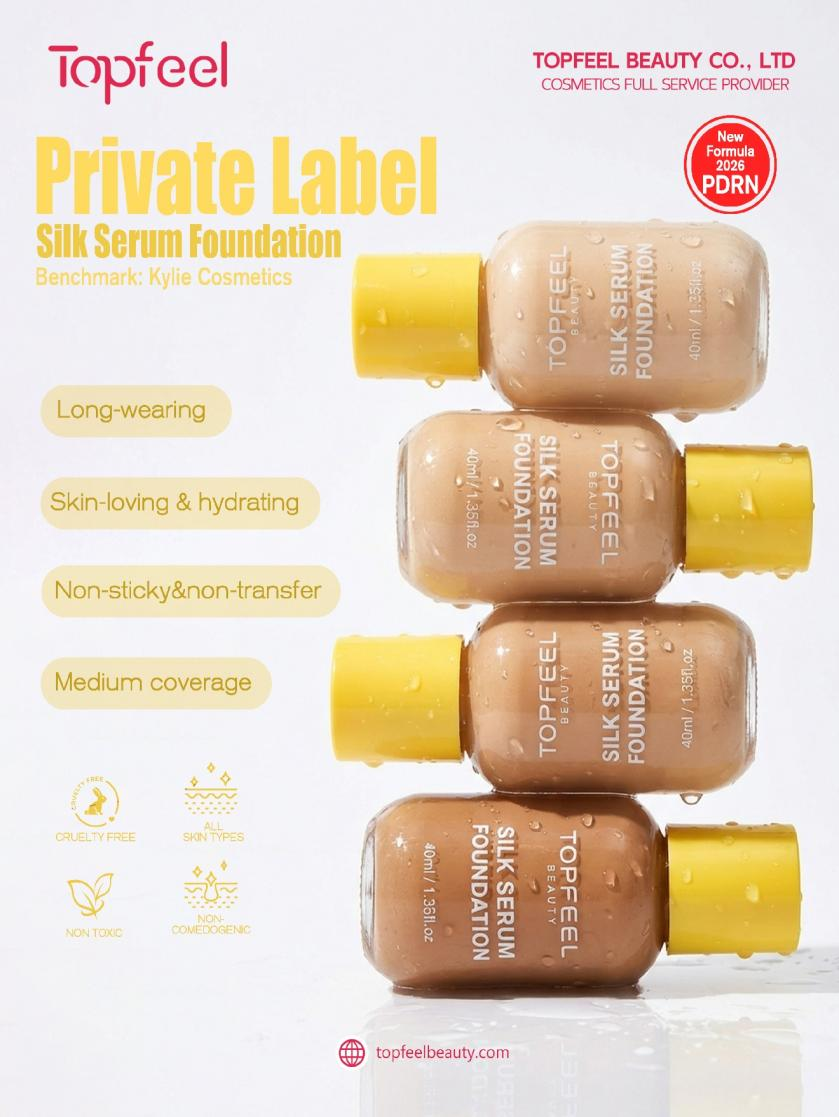
Consumers with redness-prone or rosacea-affected skin frequently seek buildable coverage that conceals uneven tone without feeling suffocating. Drawing from specialized development frameworks across foundation categories-ranging from serum-infused liquid foundations and hydrating cushions to mineral pressed powders-formulators utilize breathable elastomer networks and non-comedogenic emollients like plant-derived squalane.
Instead of forming an impermeable seal over the skin, these lightweight matrix structures allow natural moisture vapor exchange while locking pigments in place against sweat and humidity. Furthermore, pH-balanced buffering systems maintain the finished formula within the skin’s natural mildly acidic range (pH 5.0 to 5.5), protecting the resident skin microbiome during eight to twelve hours of wear.
4. What quality management and testing protocols validate sensitive-skin claims for global export?
Exporting sensitive-skin cosmetics to regulated markets such as the European Union, the United States, Japan, and South Korea requires documented safety substantiation beyond basic manufacturing hygiene. Within its OEM/ODM services, Topfeel Beauty integrates standardized quality management systems-including ISO 22716 and GMPC compliance-across every stage of production.
Before mass production is approved, custom sensitive-skin formulations undergo accelerated stability testing across extreme temperature and humidity cycles, microbial challenge testing (USP 51 / ISO 11930) to verify preservative efficacy, and third-party human repeat insult patch testing (HRIPT) or dermatologist-supervised clinical irritation assessments. Full regulatory documentation, including Ingredient Lists (INCI), Material Safety Data Sheets (MSDS), and Certificate of Analysis (COA) records, accompanies export shipments to streamline customs clearance and retail compliance.
5. How does packaging engineering protect preservative-minimal sensitive formulas?
When a cosmetic formula minimizes synthetic preservatives to protect sensitive skin, primary packaging becomes an active component of product safety. Exposure to ambient air, light, and repeated finger contact introduces oxidation and bacterial contamination risks.
Topfeel Beauty pairs sensitive-skin formulations with protective packaging architectures, including airless pump bottles, UV-shielded dispensing tubes, and precision-sealed compact cases. Airless dispensing systems prevent backflow of oxygen into the reservoir, preserving active soothing ingredients and eliminating the need for high concentrations of chemical stabilizers throughout the product’s consumer lifecycle.
Real-World Applications: Translating Sensitive-Skin Standards into Market-Ready Product Lines
The practical value of rigorous formulation and quality control becomes clearest when applied to specific commercial product categories where sensitivity risks are highest:
Post-Procedure and Redness-Correcting Complexion Lines: Skincare-makeup hybrid brands targeting consumers with compromised barriers after dermatological treatments utilize soothing liquid foundations and green-tinted color correctors. By combining micro-coated mineral pigments with niacinamide and squalane in airless dispensers, brands offer immediate visual coverage alongside barrier recovery support.
Ophthalmologist-Tested Eye Makeup Collections: For contact lens wearers and consumers prone to watery, reactive eyes, clean mascara, gel eyeliner, and cream shadow formulations eliminate volatile solvents, carbon black impurities, and flaking fibers. Smooth lipid-coated pigments adhere cleanly to lashes and lids without migrating into the tear film.
Barrier-Repair Lip Tints and Balms: Lip skin lacks sebaceous glands and is especially vulnerable to chapping and allergic cheilitis. Replacing synthetic dyes and menthol-based plumpers with purified mineral lake pigments, shea butter, and plant sterols enables brands to launch vibrant lip oils and satin lipsticks suitable for chronically dry lips.
Planning Your Next Sensitive-Skin Cosmetic Launch
For brand founders, product managers, and retail sourcing teams preparing to expand or reformulate a sensitive-skin makeup assortment, aligning technical specifications early in the development cycle reduces regulatory delays and reformulation costs. Whether developing a breathable serum foundation with SPF mineral protection, a fragrance-free eye shadow palette, or a clinically tested lip care-color hybrid, key parameters-including target regional compliance standards (EU, FDA, or APAC), preferred pigment finish, and airless or barrier-protective packaging formats-can be tailored directly to your brand positioning.
To review formulation capabilities, custom packaging engineering, and end-to-end OEM/ODM production workflows, explore the official portal at https://www.topfeelbeauty.com/
Topfeel Beauty
Topfeel Beauty
Legal Disclaimer:
EIN Presswire provides this news content “as is” without warranty of any kind. We do not accept any responsibility or liability
for the accuracy, content, images, videos, licenses, completeness, legality, or reliability of the information contained in this
article. If you have any complaints or copyright issues related to this article, kindly contact the author above.

Media gallery