SHANNON, CLARE, IRELAND, May 22, 2026 /EINPresswire.com/ — Announcing a new publication from Opto-Electronic Advances; DOI 10.29026/oea.2026.250244.
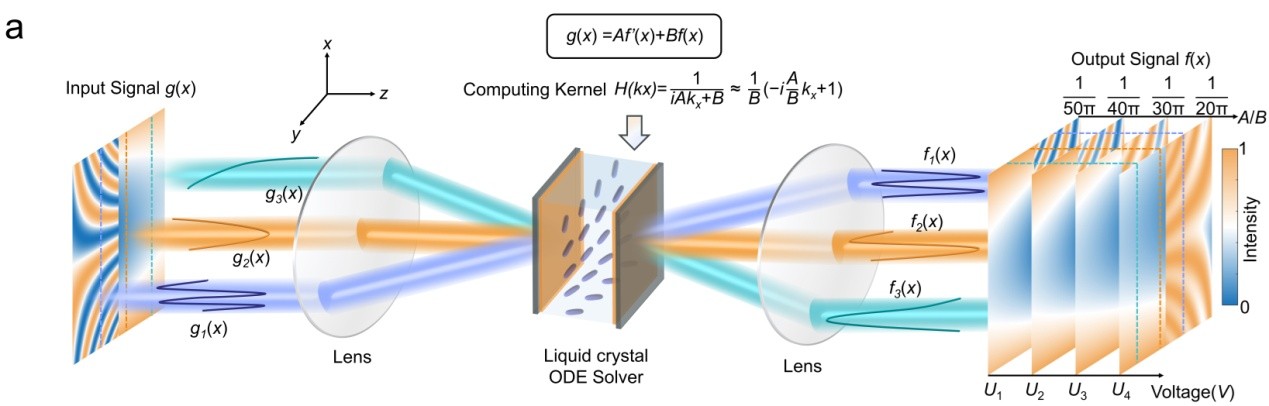
Based on the tunable liquid crystal platform, arbitrary function parallel input and differential equation coefficient regulation are realized in the spatial and temporal domains respectively. Experiments demonstrate the parallel solution of 158 variable-coefficient differential equations through a single optical transmission.
Differential equations serve as the core mathematical language for describing natural laws. From the operation and evolution of celestial bodies in the universe, the simulation and prediction of natural climates, to the interweaving and collision of micro-particles, the dynamic laws of the myriad worlds are embodied in their formulations. However, the vast majority of differential equations have complex forms and are difficult to solve analytically, thus numerical computation methods are often adopted. As we all know, traditional electronic computing methods face bottlenecks in processing speed and efficiency when dealing with massive amounts of data. Therefore, all-optical computing, characterized by low energy consumption and high speed, is regarded as a highly promising breakthrough direction.
Currently, optical solutions for differential equations mainly consist of two architectures: “spatial domain” and “temporal domain”. The “spatial domain” architecture (which simulates input functions using spatial distribution) inherently possesses the capability of parallel processing of large datasets. Nevertheless, once the device is fabricated, its functionality becomes fixed, making it impossible to adjust the coefficients of the differential equations. The “temporal domain” architecture (which achieves dynamic temporal tuning through classic structures such as resonant micro-rings and Mach-Zehnder interferometers) enables changes to the equation coefficients. However, its parallel solving capability often relies on complex and expensive multi-channel multiplexing technology. How to simultaneously achieve efficient parallel processing capability and flexible variable-coefficient solving constitutes a significant challenge in the field of all-optical computing.
The authors of this article have provided a solution to this challenge. They proposed an all-optical reconfigurable differential equation solver based on electrically tunable liquid crystals, which for the first time efficiently integrates the inherent parallel solving advantages of the spatial domain architecture with the dynamically tunable capabilities of the temporal domain architecture. Efficient solving of variable-coefficient differential equations in multiple scenarios has been demonstrated.
The research team implemented the solution of first-order variable-coefficient differential equations based on the classic 4f system. The researchers designed the input function of the differential equation as the input end of the 4f system, the function to be solved as the output of the 4f system, and the coefficients of the differential equation were simulated by designing a filter on the frequency spectrum plane of the 4f system. In this study, the 4f filter was implemented based on a tunable liquid crystal device. The research found that the transfer function of the differential equation can be accurately simulated by the tunable liquid crystal device: there is a clear functional mapping relationship between the spatial frequency kx and the in-plane azimuth angle of the liquid crystal, and the coefficients of the differential equation also have a clear functional relationship with the dynamic phase of the liquid crystal. Since the dynamic phase of the liquid crystal can be flexibly adjusted through electronic control, this means that the coefficients of the differential equation can be changed at any time with the control voltage. At the input end, since the input function only occupies one column in space, different input functions can be arranged and designed in different columns, thereby realizing the multi-input parallel computing function. The above innovative design fully combines the parallel capability of spatial domain computing and the tunable capability of temporal domain computing. Only one optical propagation is required to simultaneously record and obtain the solution results of N variable-coefficient differential equations at the output end of the 4f system (where N is the number of input functions).
In the experiment, the research team demonstrated the ability to achieve parallel computing of 158 differential equations in a single operation, as well as the simple and efficient solution of practical physical problems such as heat conduction and RC cascade circuits. The experimental results under different input functions and equation coefficients are highly consistent with the theoretical results, verifying the effectiveness of the method proposed by the team. The most prominent feature of this new type of solver lies in its powerful parallel computing and reconfigurable solving capabilities. Unlike traditional computing methods that require step-by-step calculation of a single equation, this all-optical solver can solve multiple differential equations simultaneously, greatly improving computing efficiency.
From the perspective of computing mode, spatial domain computing inherently possesses parallel processing capabilities, while optical computing has the advantages of high speed and low energy consumption. The combination of the two endows this scheme with significant potential in high-throughput data processing scenarios. In addition, the system also supports multi-wavelength signal processing, providing possibilities for multi-channel and broadband parallel computing. In the future, by introducing time-varying input signals, its processing throughput is expected to be further improved. Compared with metasurface schemes based on precision micro-nano processing, the liquid crystal scheme maintains high computing performance while featuring more flexible preparation processes and lower costs; compared with complex temporal domain multiplexing systems, its parallel processing method is more direct and efficient. This work opens up a new path for the development of high-speed, compact, multi-channel, and reconfigurable all-optical parallel information processing systems, and has broad application prospects in fields such as all-optical diffractive neural networks, real-time image recognition, and signal processing in the future.
Keywords: photonics computing, ordinary differential equations, photonic differential equation solver
# # # # # #
Zile Li Obtained his doctoral degree from Wuhan University in 2018. From June 2018 to March 2022, he conducted postdoctoral research at Wuhan University. Since April 2022, he has been a researcher at Wuhan University. His research interests include metasurfaces, holography, and related fields. http://eis.whu.edu.cn/index/szdwDetail?rsh=00032014&newskind_id=20160320222026165YIdDsQIbgNtoE
Peng Chen, Associate Professor/Doctoral Supervisor at Nanjing University. He obtained his bachelor’s and doctoral degrees from Nanjing University successively. His main research focuses on the design and construction of liquid crystal micro-nano structures, on-demand regulation of multi-dimensional optical fields, and the development and application of intelligent dynamic optical components. https://eng.nju.edu.cn/cp1/main.htm
Guoxing Zheng, Professor/Dean of the School of Electronic Information, Wuhan University. He mainly engages in the research of optical metasurfaces, information devices, and system integration, focusing on the innovation and application of metasurfaces in fields such as optical imaging, optical sensing, and optical communication. https://jszy.whu.edu.cn/zhengguoxing/zh_CN/index.htm
# # # # # #
Opto-Electronic Advances (OEA) is a high-impact, open access, peer reviewed SCI journal with an impact factor of 22.4 (Journal Citation Reports 2024). OEA has been indexed in SCI, EI, DOAJ, Scopus, CA and ICI databases, and expanded its Editorial Board to 41 members from 17 countries.
# # # # # #
More information: http://www.oejournal.org/oea
Editorial Board: http://www.oejournal.org/oea/editorialboard/list
All issues available in the online archive (http://www.oejournal.org/oea/archive).
Submissions to OEA may be made using ScholarOne (https://mc03.manuscriptcentral.com/oea).
ISSN: 2096-4579
CN: 51-1781/TN
Contact Us: oea@ioe.ac.cn
Twitter: @OptoElectronAdv (https://twitter.com/OptoElectronAdv?lang=en)
WeChat: OE_Journal
# # # # # #
Wang JH, Chen W, Zhou Z et al. Massively parallel and programmable photonic differential equation solver. Opto-Electron Adv 9, 250244 (2026). DOI: 10.29026/oea.2026.250244
Opto-Electronic Advances Editorial Office
Opto-Electronic Advances
+86 591 2286 1222
email us here
Legal Disclaimer:
EIN Presswire provides this news content “as is” without warranty of any kind. We do not accept any responsibility or liability
for the accuracy, content, images, videos, licenses, completeness, legality, or reliability of the information contained in this
article. If you have any complaints or copyright issues related to this article, kindly contact the author above.

Media gallery